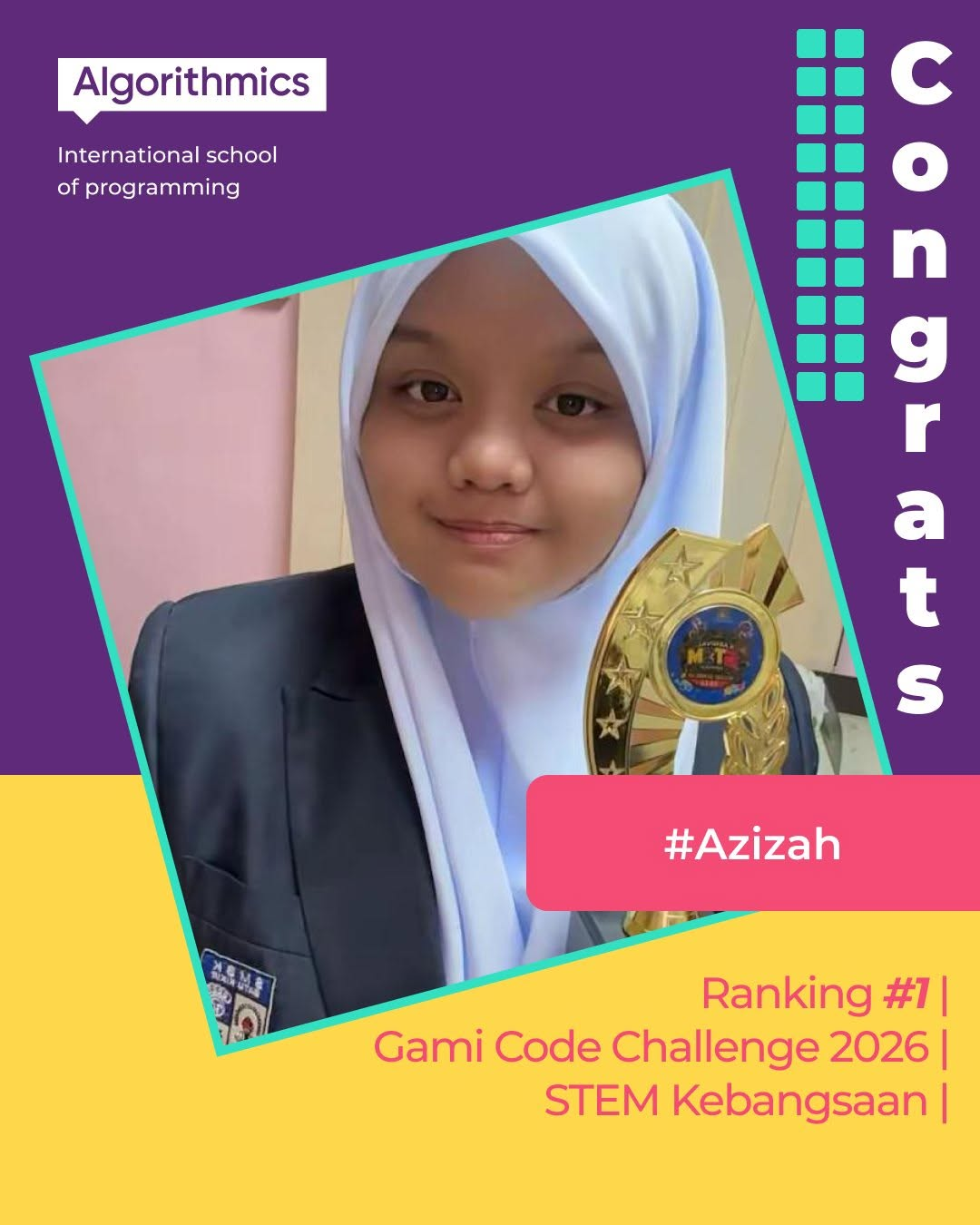
Every so often, a student reminds us exactly why we do this. Azizah, from our Algorithmics Seremban center, took first place at the Gami Code Challenge with a game she built in Scratch — and she almost didn't believe it when they called her school's name. We sat down with Azizah and her teacher, Shazwan, to hear how the project came together, what happened behind the scenes at the center, and what that winning moment actually felt like.
Q1: Tell us about the project itself. What game or project did Azizah build to win the Gami Code Challenge? How did it work, how long did she spend on it, and what was the hardest part to get right?
In this game, you play as a bored traveler who sets off on an adventure. Along the way, you discover a hidden treasure. Will you waste the money, or make smart choices and become rich?
The game has 2 chapters and 3 difficulty levels:
Q2: What did the coaching look like? How did your team prepare her? What did the teacher do that she couldn't have figured out on her own — the specific moments where the center made the difference?
Teacher Shazwan: We didn't need to prepare her much because she arrived very well prepared. The only challenge was that she was facing issues with her preparation. We asked her to share what she had prepared, and that night at the center, the team reviewed it to figure out what was going wrong with her approach. The next day, we all sat down together, including the student, to go through the solution.
Her project involved Scratch games. While it is easy to create events in Scratch, that is also its worst nightmare: as the project progresses, events end up triggering everywhere instead of happening only when intended.
To fix this, we practically restructured everything without changing the core context or functionality of her events. This completely flipped the program from a disoriented mess into a clean, well-functioning project. That is where the center really made the difference, I suppose.
Q3: What was the moment of winning like? When the result was announced, what happened? How did Azizah react, what did she say, how did her family and the team respond?
We presented our project at 11:00 AM, and the results were announced on 25 June at around 4:00–5:00 PM. While we waited, we were nervous because we felt our presentation wasn't our best. We were hoping to place in the top three.
When the third and second places were announced, and our school name was not called, we looked at each other in shock. That was when we realized we might have won first place. When our school's name was finally announced as the winner, we were extremely happy and couldn't believe it.
After receiving the trophy, my partner and I were excited and shocked. Our teacher was also surprised because she didn't expect us to win. We later told her that we were actually nervous and thought our presentation had gone badly, but we didn't want to worry her. We all laughed about it together.
I shared the good news with my mother, and she congratulated me and encouraged me to continue improving for future competitions. It was a memorable moment because all our hard work finally paid off.
In this game, you play as a bored traveler who sets off on an adventure. Along the way, you discover a hidden treasure. Will you waste the money, or make smart choices and become rich?
The game has 2 chapters and 3 difficulty levels:
- Chapter 1 – Travel (Easy): Learn how to choose the best travel package, avoid scams, and spend money wisely through fun maths and decision-making questions.
- Chapter 2 – Investment (Medium & Hard): Test your skills with compound interest and investment challenges. The higher the level, the harder the questions!
Q2: What did the coaching look like? How did your team prepare her? What did the teacher do that she couldn't have figured out on her own — the specific moments where the center made the difference?
Teacher Shazwan: We didn't need to prepare her much because she arrived very well prepared. The only challenge was that she was facing issues with her preparation. We asked her to share what she had prepared, and that night at the center, the team reviewed it to figure out what was going wrong with her approach. The next day, we all sat down together, including the student, to go through the solution.
Her project involved Scratch games. While it is easy to create events in Scratch, that is also its worst nightmare: as the project progresses, events end up triggering everywhere instead of happening only when intended.
To fix this, we practically restructured everything without changing the core context or functionality of her events. This completely flipped the program from a disoriented mess into a clean, well-functioning project. That is where the center really made the difference, I suppose.
Q3: What was the moment of winning like? When the result was announced, what happened? How did Azizah react, what did she say, how did her family and the team respond?
We presented our project at 11:00 AM, and the results were announced on 25 June at around 4:00–5:00 PM. While we waited, we were nervous because we felt our presentation wasn't our best. We were hoping to place in the top three.
When the third and second places were announced, and our school name was not called, we looked at each other in shock. That was when we realized we might have won first place. When our school's name was finally announced as the winner, we were extremely happy and couldn't believe it.
After receiving the trophy, my partner and I were excited and shocked. Our teacher was also surprised because she didn't expect us to win. We later told her that we were actually nervous and thought our presentation had gone badly, but we didn't want to worry her. We all laughed about it together.
I shared the good news with my mother, and she congratulated me and encouraged me to continue improving for future competitions. It was a memorable moment because all our hard work finally paid off.
Azizah isn't the only one making us proud—read Gloria's story: a 12-year-old from our Málaga center competing at Stanford this summer