
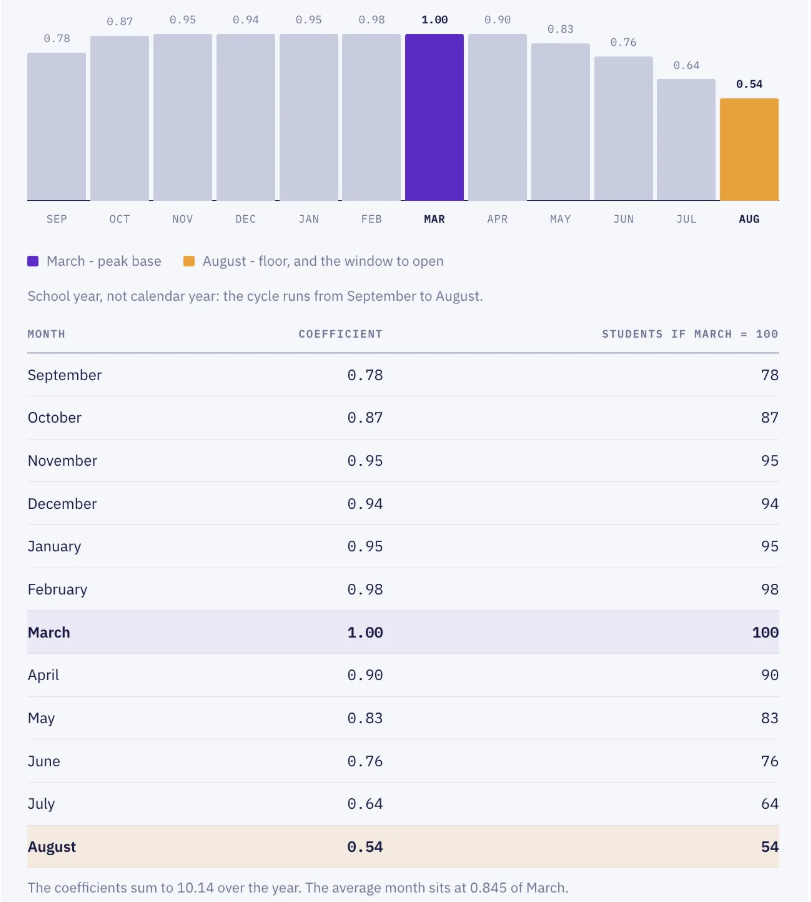
Enrollment peaks in March. It bottoms out in August. The gap between them is nearly two-to-one, and the center's fixed costs over the same period don't move at all. The best time to open is August and September, when the numbers are lowest.
Below are the coefficients for all twelve months, what they mean for cash and for hiring, and why May is the most expensive month to start.
How this was calculated
- Data from more than 500 network offices: Romania, Morocco, Mexico, France, Germany, Venezuela, Ecuador, and other markets across 90 countries of operation. Tracked in detail from 2021 to 2026, over the first 12 months of each center's life.
- The unit has active students at month-end. No leads and no new sign-ups: seasonality on new sign-ups is noticeably sharper.
- March is set at 1.00. Every other month is a share of March.
- Seasonality is separated from growth. This is the shape of the curve inside a single school year. Network growth is applied as a separate multiplier and is not shown here.
Coefficients by month
What the coefficients mean for cash
Rent, the core of payroll and license payments, is flat. They are the same in March and in August. The base, meanwhile, moves by 46% off the peak. Utilisation follows a curve while costs follow a straight line. The month you open decides which part of the curve your first months of operation land on, and that is worth factoring into working capital planning.
The clearest way to compare is the share of annual demand that falls into a center's first six months.
The clearest way to compare is the share of annual demand that falls into a center's first six months.
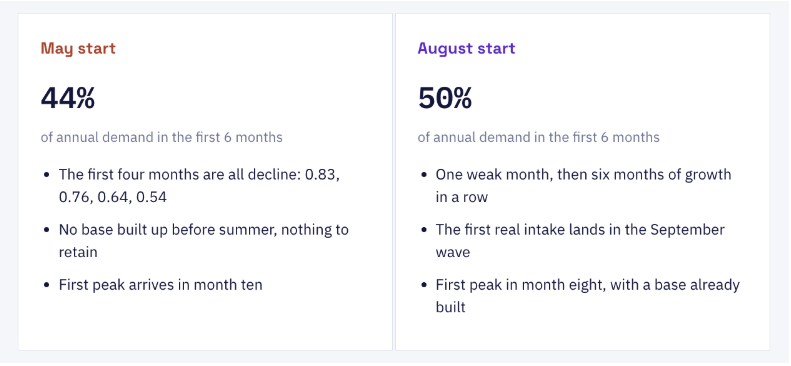
A September start gives 54% of annual demand in the first six months. That is the upper bound, and it comes with a condition: preparation has to be finished in August, or the center misses the very wave it opened for.
July and August are not zero
The 0.54 index in August describes students in regular groups, not revenue. These are two different things, and mixing them up is costly.
Families travel in summer and regular groups thin out, but demand for short formats holds. Week-long camps and intensives sell as a package and are paid upfront; the per-week price is higher than a month of regular classes, and the space and teachers are already paid for. In centers that run a summer program, revenue in July and August falls about half as steeply as the number of students in groups.
The practical conclusion: closing the center for the summer costs more than it looks. It removes not only summer revenue but also the point of contact with parents one month before the September intake.
Families travel in summer and regular groups thin out, but demand for short formats holds. Week-long camps and intensives sell as a package and are paid upfront; the per-week price is higher than a month of regular classes, and the space and teachers are already paid for. In centers that run a summer program, revenue in July and August falls about half as steeply as the number of students in groups.
The practical conclusion: closing the center for the summer costs more than it looks. It removes not only summer revenue but also the point of contact with parents one month before the September intake.
What the coefficients mean for hiring
- Teachers need to be hired, trained, and certified by mid-August. That means recruiting in June and July, when the market is open and cheaper.
- In September every center in the city that did not prepare is competing for the same people. Searching then takes longer and costs more.
- In July and August there is not enough work to keep a teacher fully loaded. That is planned underutilization, not an operating mistake, and it should be included in the budget in advance. Summer camps close part of the gap.
Why May is the most expensive mistake
- Four consecutive months of falling demand. In every early operating month, the most expensive and most fragile ones run against the curve.
- No base built up before summer. Summer churn hits groups that have not formed yet. There is nothing to retain, and the owner reads the churn as a product failure.
- Working capital goes to the wrong place. Money that should have funded the September intake is spent surviving July and August. By the time the main wave of the year arrives, the marketing budget is gone.
- The first peak lands in month ten. The owner sees normal numbers almost a year after the investment. Some partners make an exit decision in that window even though the model was sound.
August and September as the window
The logic follows directly from the table. Opening in August means the fit-out, the hiring, and the first trial lessons all happen in the quietest month, when mistakes are cheapest. The first real intake lands in the September wave. From there the base goes through six months of uninterrupted growth, and the center's first full season closes on the peak rather than the floor.
A weak month is the best time to open precisely because it is weak. In August, there is no base to lose while you set up processes, and you have a full month to get the schedule right before the money arrives.
A weak month is the best time to open precisely because it is weak. In August, there is no base to lose while you set up processes, and you have a full month to get the schedule right before the money arrives.
Limits of the model
The curve is built around the Northern Hemisphere and tied to a school calendar that starts in September. In other markets, it shifts.
MENA. The cycle moves by roughly one month. In practice,, that means a different schedule: prepare in August, open in September, and grow fully from October. Ramadan needs to be planned separately. Its dates move about 11 days earlier every year, so it cannot be pinned to a month: in 2026 Ramadan fell across February and March, and it will keep shifting earlier in the years ahead. It currently overlaps the period that produces the peak in Europe, which means the March peak does not hold in MENA in its usual form. We plan the dip in activity during Ramadan, along with the schedule and the marketing budget, rather than addressing it afterward.
Latin America. Some countries run an August-to-September school calendar, and others run a February one. Both appear in the network, sometimes within the same region. In a February-start market, the curve inverts, which also opens a second launch window, and intake must be planned across two cycles instead of one.
We publish the northern hemisphere curve as the baseline. We recalculate the curve for a specific market with the partner, based on their school-year calendar.
MENA. The cycle moves by roughly one month. In practice,, that means a different schedule: prepare in August, open in September, and grow fully from October. Ramadan needs to be planned separately. Its dates move about 11 days earlier every year, so it cannot be pinned to a month: in 2026 Ramadan fell across February and March, and it will keep shifting earlier in the years ahead. It currently overlaps the period that produces the peak in Europe, which means the March peak does not hold in MENA in its usual form. We plan the dip in activity during Ramadan, along with the schedule and the marketing budget, rather than addressing it afterward.
Latin America. Some countries run an August-to-September school calendar, and others run a February one. Both appear in the network, sometimes within the same region. In a February-start market, the curve inverts, which also opens a second launch window, and intake must be planned across two cycles instead of one.
We publish the northern hemisphere curve as the baseline. We recalculate the curve for a specific market with the partner, based on their school-year calendar.
Frequently asked questions
When is the best time to open a kids' coding school?
August and September. Preparation runs through July and August, enrollment opens with the school year, and the center sees six consecutive months of rising demand, peaking in March. Roughly 54% of annual demand falls into the first six months of operation.
Which month is the weakest for enrollment?
August is at an index of 0.54, compared with 1.00 in March. July is the second weakest at 0.64. Revenue falls more gently than student count when camps and intensives run over the summer.
Why is May a bad month to open?
The first four months of operation land on falling demand. The center enters the summer with no accumulated base; working capital goes to survival instead of preparing for the September wave, and the first peak arrives only in month ten.
How much working capital does a summer launch need?
Fixed costs do not change month to month, while the base moves by 46%. A May start needs reserves that cover the summer and the marketing for the September wave. An August start closes the gap faster, because demand rises continuously after the first month. The exact figure comes out of the local model: rent, payroll, and cost per lead vary widely.
How does seasonality affect hiring teachers?
The team has to be ready by mid-August, which means recruiting in June and July while the market is open. In September, those who didn't prepare are competing for the same people.
Does seasonality differ by country?
Yes. In MENA, the cycle shifts by a month, and Ramadan overlays it, with dates that move each year. Latin America runs two school calendars in parallel: August to September, and February.